
A quirky look at how sometimes some of our Saints live. Their lives are shaped by prayer, humility, and courage. They carry their faith in the ordinary moments.
Fifth Sunday of Lent
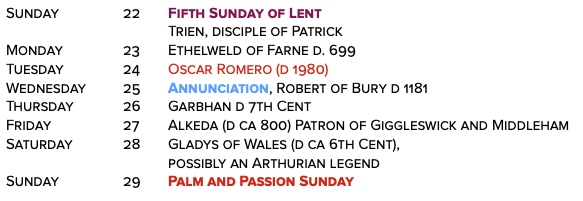
Strength in the Week Before the Cross
A Celtic Pilgrimage through the Saints of the Coming Days
In the last days before Holy Week, the Church walks quietly toward Jerusalem.
The Gospel will soon show Christ entering the city on a donkey, welcomed with palms and praise. Yet beneath the surface of the celebration lies another road — the road that leads toward the Cross.
It is fitting that the saints remembered in these days do not show the strength the world expects. Their lives reveal something deeper: the quiet strength that grows in those who follow Christ along the pilgrim road.
Seen together, they form something like a small rule of strength for the days before the Cross.
The Strength of Receiving
Trien, disciple of Patrick
The week begins with Trien, remembered simply as a disciple of Patrick. We know almost nothing about him beyond that relationship.
And yet that small detail tells us something important.
Before anyone proclaims the Gospel, someone must first get it. The faith spreads not only through apostles but also through disciples. These are men and women who quietly accept the breath of God. They carry it into the next place.
The first strength of the Christian life is not achievement but receptivity.
The Strength of Rootedness
Ethelwold of Farne
Ethelwold lived on the windswept Farne Islands off the coast of Northumbria. His name may even mean “strength of the forest.”
It is a fitting image. The forest grows slowly, tree by tree, root by root.
Ethelwold’s strength was not dramatic. It was the strength of prayer, solitude, and perseverance in a place shaped by wind and sea.
In a restless world, rootedness itself becomes a form of strength.
The Strength of Truth
Oscar Romero
Then the week turns suddenly outward.
Oscar Romero, Archbishop of San Salvador, found himself called to speak when violence and injustice surrounded his people. What began as a pastoral concern became a prophetic witness.
His strength was not aggression but truthfulness.
Even knowing the danger, he continued to speak for the poor and the voiceless.
The Gospel sometimes requires the courage to speak when silence would be easier.
The Strength of Listening
Robert of Bury
Robert of Bury shows another form of strength — the strength of attentiveness.
In the monastic tradition, scripture is not rushed. It is read slowly, prayerfully, repeatedly.
The monks believed that careful listening to the Word of God reshapes the heart over time.
Strength grows in the quiet discipline of listening.
The Strength of Place
Garbhan
Many early Celtic saints are remembered not for great deeds but for the holiness they brought to a particular place.
Garbhan belongs to this tradition.
These saints remind us that faith does not always travel far. Often it grows deep in the soil of a particular village, parish, or landscape.
The strength of the Gospel is sometimes simply the strength of remaining faithful where we are planted.
The Strength of Hidden Holiness
Alkeda of Giggleswick
Alkeda’s story is largely hidden from history, yet her memory endured in the communities she served.
This is the strength of lives that are never widely known.
Much of the Kingdom grows quietly — in acts of kindness, faithfulness, and prayer that history rarely records.
Yet heaven remembers them.
The Strength of Turning Again
Gladys of Wales
Gladys appears in Welsh tradition as a figure whose life moved toward repentance and transformation.
Her story reminds us that holiness is not about never falling. It is about the willingness to turn again toward God.
Conversion requires courage.
The strength to change direction may be one of the deepest strengths of all.
The Strength of the Cross
These companions guide us through the final days before Palm Sunday.
Receiving. Rootedness. Truth.
Listening. Faithfulness in place.
Hidden holiness Turning again.
Faith is always crossing Faith, a trust lesson
Faith nurtured in daily prayer
Faith still ebbs and flows
Hidden holiness. Turning again
All of them prepare us for the strength we will soon see revealed in Christ himself.
For when Jesus enters Jerusalem, the strength he reveals will not be the strength of power or conquest.
It will be the strength of love that does not turn away from suffering.
The saints of this week remind us that this strength is already at work in many quiet lives.
Like pilgrims walking the road together, they join the Church as we approach the mystery of the Cross.
And in their lives we glimpse the same truth that breathes through the Gospel:
The strength of God is often hidden.
But it is strong enough to carry the world.
Fourth Sunday of Lent, March 15th, 2026
(Mothering Sunday)

Weekly Diary
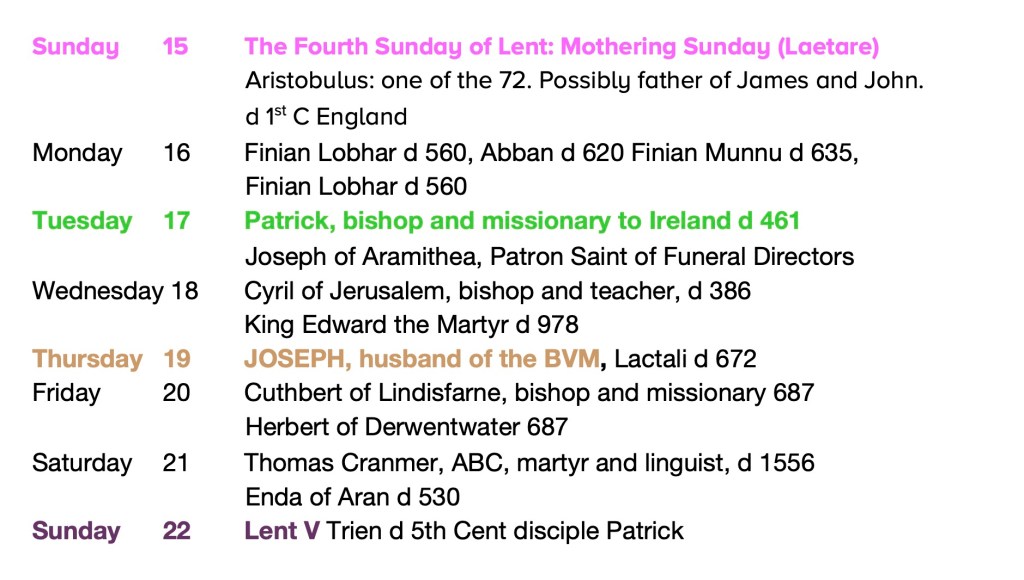
Sunday 15 The Fourth Sunday of Lent: Mothering Sunday (Laetare)
A reflection for the week after Mothering Sunday
Before the Gospel was written, it was lived. It was carried in the hearts and hands of those whose faith shaped communities across generations. After Mothering Sunday, the Church remembers those who nurtured faith. This group includes missionaries who braved unknown seas. It also includes teachers who opened the mysteries of baptism. Pastors led their people toward holiness, and guardians sheltered fragile belief. In their stories, faith is kept not by structures alone, but by courage, by friendship, by prayer.
After Mothering Sunday, we are invited to remember spiritual parenthood—the quiet, patient work of those who nurture faith in others.
Patrick was Ireland’s spiritual father. Cyril of Jerusalem was a teacher of baptismal catechesis. Cuthbert of Lindisfarne was a shepherd of Northumbria. Thomas Cranmer was an architect of Anglican liturgy. They all left permanent legacies.
Patrick’s life is marked by two sea crossings. First, he was captured and enslaved across the Irish Sea. Then, he returned as a missionary. Water plays a transformative role, taking him from captivity to mission. His journey mirrors baptism: descent, change, and return.
Many of the saints remembered this week made their homes on islands. They lived at the water’s edge, drawn to those places where land meets sea. Cuthbert of Lindisfarne withdrew to Inner Farne—a small, windswept island in the North Sea. There, among seabirds and storms, he sought solitude. He dedicated himself to prayer. He longed for a heart made pure. He desired a life drawn close to God. Even in his solitude, pilgrims crossed the waters to seek his counsel.
Herbert of Derwentwater offers another glimpse of island solitude. On St Herbert’s Island, he lived apart, yet each year he and Cuthbert met for prayer. Though water lay between them, friendship bridged the distance—a quiet companionship shaped by prayer.
Enda of Aran follows the same pattern. His monastery on Inis Mór became a place of formation for Celtic monks. These islands were seen as thin places, where heaven and earth draw near.
Early Celtic monks chose islands with intention. Water became their teacher: distance from the world, the crossing as pilgrimage, dependence on boats and tides and weather. Each journey to the mainland was a lesson in trust. For these monks, the sea was their desert—not sand, but wind and waves. Cuthbert by the shore, Herbert in prayer on his island, all echo the journey of baptism.
Faith, too, is always a crossing—stepping beyond what is familiar, seeking the place where growth begins.
Faith is a journey across landscapes. This week’s arc begins in Jerusalem with Cyril. It travels through the Mediterranean toward Britain. It continues to Ireland at the Atlantic and North Sea. The Gospel spreads like an ocean tide, from the Jordan to the Irish and North Seas, then to Cumbria’s lakes.
This imagery connects to Gippsland. Around the lakes, water shapes life—tides, channels, islands, boats, pelicans on the wind. As Celtic saints found God through rhythms of sea and tide, this spiritual language speaks by lakes and estuaries.
The Gospel travels well across water. From Jerusalem to Ireland, faith often grows where land meets water. From Lindisfarne outward, it reminds us we are pilgrims. We are always crossing and trusting grace’s currents.
Here, faith is shared and nurtured. We gain strength in our journey. We find strength in friends. Prayer gives us strength. We also gain strength through the awareness of thin spaces where God is here.
Not only to speak the Gospel,
but to live it.
Faith that the boat floats
Faith that crosses the water
Faith journeys, and grows
Faith revealed in lives
Faith on lands girt by the sea
Faith always crossing
Faith a trust lesson
Faith nurtured in daily prayer
Faith still ebbs and flows
DW26
Third Sunday of Lent, March 8th, 2026
Sunday 08 The Third Sunday of Lent (Duthac of Ross and Tain d 1050)
Monday 09 Bosa of York (d 705), Sr Emma SSA (d 1939)
Tuesday 10 Kessog of Lennox, Loch Lomond (d 520)
Wednesday 11 Constantine, former King of Cornwall, missionary monk with Mungo (d ca 576)
Thursday 12 Mura McFeredach, disciple of Colomba, patron of Fahan (d 645)
Friday 13 Mochelloc (d 639) Patron of Limerick, aka Celloch, Cellog, Motalogus, Mottelog.
Saturday 14 Queen Mathilda of Germany (d 968) A noble Saxon mother to two awful boys
Sunday 15 The Fourth Sunday of Lent: Mothering Sunday (Laetare)
Aristobulus: one of the 72. Possibly father of James and John. d 1st C England
Revealed in lives, not letters.
A reflection for the week before Mothering Sunday
At the northern edges of the islands of Britain, the Trinity did not arrive as words or sermons. It moved quietly. It walked the rough paths beside lochs and rivers. It was carried in the lives of those who followed Christ where they were sent. Even now, the Gospel comes quietly. It shows up in a neighbour’s kindness. It shows in the steady courage of a community that endures. It is clear in the quiet faithfulness of those who serve unseen. The story of God’s love unfolds in these ordinary acts. It still walks with us where we live. It guides us along the paths we know.
We remember Duthac of Ross, whose quiet holiness drew pilgrims to the far north. In Kessog of Lennox, faith appears beside the waters of Loch Lomond. Here, the Gospel takes root in a land of hills and mist.
Through Mura McFeredach, we glimpse the living chain of discipleship flowing from Columba of Iona. Teacher to disciple. Elder to younger. Life shaping life. Faith does not spread by command, but by companionship.
Some of these saints carried crowns before they carried the cross. Constantine of Cornwall laid aside power to follow Christ in humility. Centuries later, Matilda of Ringelheim found another path to holiness. She used her wealth and influence to care for the poor and to build communities of prayer.
Others are known to us only faintly. Their names echo through place and memory. Mochelloc is more a presence in the land than a figure in books. Even this is a witness. Holiness leaves its deepest marks not in written records, but in living communities.
By the time we reach the quiet devotion of Sr Emma Rawlins SSA, the pattern remains. Centuries change. Continents change. The calling does not. The Gospel is still revealed in lives offered to God.
These saints remind us that faith grows through relationship. Teacher and disciple. Parent and child. Elder and novice. This is why the Church turns toward Mothering Sunday. We remember the mothers of faith. Those who first taught us to pray, who nurtured the fragile beginnings of belief, whose quiet example shaped our journey.
As the week unfolds, I invite you to remember someone who has guided or encouraged you in faith. Thank them with a call or a simple note. If they are no longer here, remember them in prayer, with gratitude. In this way, the story of faith echoes from one life to another.
The story of the Church is not written only in libraries. It is written in lives. Lives shaped by prayer, by humility, by courage.
And so we listen again for the same call in our own time. This week, choose one small act of kindness or encouragement. A quiet visit. A helping hand. A note of thanks. Let this simple intention become your prayer, living out faith in the ordinary moments ahead.
Not only to speak the Gospel, but to live it.
Second Sunday of Lent, commencing March 1st
Sunday 01 The Second Sunday of Lent (Saint David of Wales)
Monday 02 Chad of Mercia (d 672) Patron of Astronomers, Brother of Cynibild & Cedd
Tuesday 03 Cele-Christ, Bishop of Leinster (d 782)
Wednesday 04 Nonna, husband of Sant, mother of David of Wales
Thursday 05 Piran (ca 380), Cornwall. Patron of Tin Miners
Friday 06 Bilfrid, (ca 715). Silversmith who bound the Lindisfarne Gospels
Saturday 07 Esterwine (d 668) Nobel born; Abbot of Monkwearmouth-Jarrow Abbey
Sunday 08 The Third Sunday of Lent (Duthac of Ross and Tain d 1050)
This coming week’s calendar carries a quiet tenderness.
The names feel less like distant monuments and more like family.
We remember David of Wales — preacher, ascetic, bishop of the western hills. Yet before he was a saint, he was simply a son. The Church also recalls Nonna, who carried him, shaped him, and prayed him into the man Wales would later claim. Before there were sermons, there was a mother’s steady faith. Before fasting and proclamation, there was the patient work of nurture.
Faith is rarely a fresh invention in a single generation. It is something handed down.
That same line runs through Chad of Mercia. Chad did not chase prominence. When his irregular appointment as bishop was challenged, he stepped aside with quiet humility. For him, authority was a trust to be received and relinquished, not a prize to be clutched. He walked on foot among his people until told to ride. The gospel was not merely on his lips; it was in his bones.
Further north, in Northumbria, devotion took on another shape. Bilfrid did not write the Lindisfarne Gospels; he bound them. He set jewels into their covers so that the Word would be honoured and kept safe. Others preached; he adorned. Others proclaimed; he preserved. Centuries on, the beauty still speaks.
In Cornwall, Piran is remembered not only as a preacher but as one who lived and worked among miners. Tin drawn out of dark rock became a sign that what is hidden can be brought to the surface. Vocation and holiness were not separate realms. The work of hands became the work of God.
In monastic houses shaped by Eosterwine, noble birth yielded to shared life. To lead was to labour beside others. Status gave way to service.
These saints are not held together by spectacle. They are joined by the simple act of passing something on.
A mother to her son.
A teacher to a student.
A craftsman to a book.
A community to its children.
Place still matters — Wales, Mercia, Cornwall, Northumbria, Ross and Tyne — coastal edges where wind and tide carve stone. Yet what endures is not the landscape alone, but love that has learned to last through daily faithfulness.
The name “Nonna” still rings across languages as grandmother: storyteller, memory-keeper, quiet strength at the heart of family life. It hints that holiness often begins in kitchens rather than cathedrals; in whispered prayers more than in public declarations.
The Lindisfarne Gospels have come through fire and raid, exile and return. They remain because someone cared enough to bind them well. Faith endures in much the same way — tended, adorned, passed on.
Perhaps this week invites us to look around gently and ask:
- Who placed faith in my hands?
- Whose prayers steadied my early steps?
- What beauty or kindness have I been given to carry ahead?
Revelation does not always arrive in epistles.
Often it is made known in love.
And love, lived faithfully over time, travels farther than we ever see.
A Benediction for What Has Been Handed On
May the God who formed you in love
Break Open
and named you before you
knew your own name
bless the memory of those
who prayed you into being.
May the faith you received —
in kitchens, in quiet words,
in steadfast example —
be strengthened in you,
and through you,
become gift for another generation.
May your days be shaped by gratitude,
your work by devotion,
your speech by kindness,
and your life by the quiet courage of the saints.
And may the love that carried you thus far
carry you still —
from tide to stillness,
from questioning to trust,
from this day into all your days.
In the name of the Father, and of the Son,
and of the Holy Spirit. Amen.
The First Sunday of Lent: week commencing February 22nd
Sunday 22 The First Sunday of Lent (Martyrs of Arabia)
Monday 23 Boswell (d 661) Abbot of Melrose, teacher of Aidan, Milburga of Shropshire (d 715)
Tuesday 24 Matthias, Apostle and Martyr
Wednesday 25 Walburga (d 779) Dorset raised, Mission to Germany with Willibad and Winebad
Thursday 26 Porphyrius (d 429) Bishop of Gaza
Friday 27 Baldomerus (d 650) Patron Saint of Locksmiths
Saturday 28 Ruellinus, Bishop of Treguier (6th Century) succeeded Trudwal
Sunday 01 The Second Sunday of Lent (Saint David of Wales)
This coming week, the Church’s calendar quietly fills with names from what we too easily call the “Dark Ages.” Yet these were anything but dark. They were centuries lit by lives — patient, courageous, local, and luminous.
We meet a remarkable gathering of saints: Walburga, Willibald, Winebald, Lioba, and Boniface. They are bound together by kinship, friendship, and a shared mission. Crossing from England into the forests of Germany, they carried not arguments but patterns of life: prayer, learning, stability, courage.
Boniface is remembered for felling the sacred oak of Thor, but this was not triumphalism. It was pastoral clarity — a way of saying that fear no longer ruled the forest. Around him stood women and men who founded monasteries, taught the faith, and shaped communities where trust grow.
Further north, another light shines.
From Iona came Aidan of Lindisfarne, walking rather than riding, teaching by companionship rather than command. Accompanying him were notable figures like Cuthbert of Lindisfarne. Others included Bosa of York, Ecgbert of Iona, and Boisil of Melrose. They were all formed by the rhythms of Melrose and Lindisfarne. Here holiness looked rugged and tender at once: seabirds, solitude, tides, and service held together.
Then there are the Mercian and Kentish royal women — Milburga, Mildred of Thanet, and Mildgytha. These are women of noble birth. They chose enclosure over court and prayer over power. Milburga’s stories speak of levitation in prayer. Whether taken literally or not, they witness to lives made light by trust in God.
If we give a gentle tilt of the leek toward David of Wales, we can hear a familiar echo. It is one of simplicity and clarity. There is monastic steadiness and holiness rooted in place.
What holds all these saints together is not clever theology written down, but theology lived out.
They show us:
- Royalty redefined — power laid aside for service
- Stability as mission — monasteries as centres of courage
- Wonder without riddles — faith so embodied that even landscapes seemed to respond
These saints did not rush history. They stayed. They prayed. They taught. They crossed seas when needed, and stayed put when faithfulness required it.
We might feel quietly longing for places like Iona, Lindisfarne, the Tyne, or Melrose. That is perhaps why so many of us find ourselves drawn to them. We do so not as nostalgia, but as recognition. Something in those stones remembers what it is like to live slowly before God.
As their feast days come around this week, we give thanks not only for their stories, but for their witness:
- that holiness is possible in uncertain times,
- that the Church is built as much by patience as by passion,
- and that light often shines most clearly where life is faithfully lived.
God of wind and wide sea,
of heathered hill and tidal shore,
who kindled your light in islands and forests
when kingdoms rose and fell:

We thank you for your servants
who walked the causeways at dawn,
who prayed among stones and seabirds,
who crossed cold waters for love of Christ,
and who chose the cloister over the crown.

As you steadied Aidan’s steps,
as you strengthened Cuthbert in solitude,
as you gave courage to Boniface in the forest,
and quiet radiance to Walburga and Milburga in prayer, so steady us.

When we cling to bright moments,
teach us to descend in trust.
When we fear the wilderness,
be our sheltering rock.

When we long for distant holy places,
plant holiness beneath our feet.
May the light that shone on Iona’s shore
and Lindisfarne’s sands
burn also in our common life —
in patience, in hospitality, in daily faithfulness.

Through Christ our Way and our Rest,
who lives and reigns with you,
in the unity of the Holy Spirit,
one God, world without end. Amen.
 Breaking Open