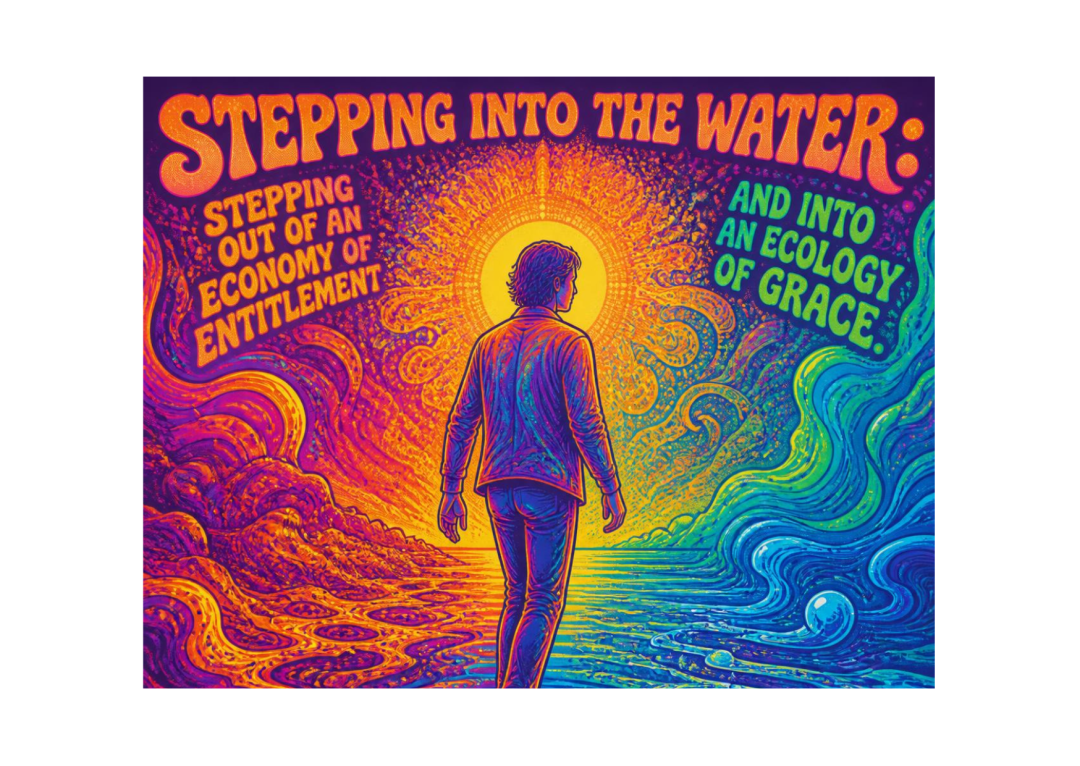
Baptism isn’t standing by Living Water admiring it. We get wet.
At a funeral recently at The Abbey on Raymond Island, a young man asked me how to get from the chapel to the beach. He was the grandson of the deceased, and as this was his first experience of death and funerals, he must have been upset and needed some quiet time, so off he went and came back much happier. I asked him if the lake had helped him. He said, “Yes. Took off my shoes, paddled in the lake. Water soothed me. I can see why gran liked this place so much.”
At first, these readings seem far from the water’s edge, but they call us out of entitlement and into the flow of grace. Gospel doesn’t ask us to stand back admiring God’s generosity; it asks us to wade in. It is not enough to be saved in name only. We are invited to follow; let our lives be formed by what it means to belong to Christ. Owning the car isn’t enough; we have to take the journey.
The readings talk of having and joining in. We linger at the threshold only because grace brought us here. Possession alone is empty if we do not enter in.
The parable of the vineyard makes us ask: what is mine, what is yours, what was earned and what was given? Who is honoured and why? This is not a story of privilege; it’s an invitation. The workers in the vineyard may grumble, but the promise remains. Each gets what was offered to him.
If I work all day in the sun, I expect to be paid for that work. But the vineyard owner gives a day’s wage, not an hourly rate. Each worker gets what he was promised. Those who worked under the heat may feel wronged, but the promise is kept. Righteousness isn’t found in hours but in the faithfulness of the giver.
As we hear these words, we take time to remember what they mean for us and for the story we are given.
In the gospel economy, work has new meanings. Liturgy is not just words on a page; it’s the people’s work. Ecology is what we do with what God has given us. Righteousness is when all things are set right, when books are balanced by grace.
The readings show how God meets us: slow to anger and rich in goodness. The psalmist praises God’s grace. Righteousness makes all things whole. Grace allows us to join in creation’s work; when we fail, God shows compassion. Love balances all on the cross, where Christ gathers our debts—to each other, our communities, and the world.
Jonah, a four-act biblical comic book, tells of Jonah hearing God’s word and refusing to go to Nineveh, a large walled city near modern Mosul, on the Tigris and Khosr Rivers. In the Assyrian Empire, it was lively but unruly. God, patient and merciful, gave them a chance to change before Babylon destroyed it.
Poor Jonah knew going there with an assurance of destruction wouldn’t be a good journey. He preferred other places and headed nowhere else. Then, God changes the weather, the crew sacrifices Jonah, and a sea beast swallows him. For three days, Jonah reflects and finally vomits onto a beach near Turkey, beginning a three-day trek across the city.
The attitude of Jonah could be called “half-hearted” and “disinterested”. After three days of repentance and fasting, the message had been given. Jonah went off to the hill country to watch God destroy the detestable evil place (but God noticed the change in the people and animals of Nineveh). He was very pleased. But a covenant or contract was being played out here. Jonah had done his bit. He told them God’s news. And then gleefully went off to watch it all happen.
A smiling God made sure Jonah was comfortable, enjoying shade, cocktails, and a tan. That’s life. The worker deserves wages. But overnight, God tells a worm to destroy paradise and causes weather to trouble Jonah. He was angry about the worm and the tree. The story ends with God saying Jonah had no right to care for his privilege under a shady tree, but was sent to save 120,000 people. God’s compassion and mercy were obvious; Jonah’s entitlement was clear.
Paul reminds us in Philippians that our life and privileges are minor compared to God’s mercy. We can’t hide anything from God, who grants grace to all. We won’t take worldly gains after death; all face judgment. Privilege doesn’t buy a bigger mansion in heaven. God’s wish is for us to follow His divine plan of eternal life, not based on wealth or status. Heaven isn’t about luxury mansions. Our blessings now are for God’s glory, not just in the afterlife.
All abundance comes from God, who is infinitely generous beyond creation’s limits. We’re called to abandon entitlement and embrace grace, caring for all life—earth, others, community—and living our faith. Like the young man at the water’s edge, we’re invited to step in, to be immersed and become true disciples.
We turn to Christ. We repent of our failings and turn to perceive the world anew. We leave behind and renounce all that destroys or harms; follow Christ; take up our burdens; move on daily. When we cling to something we think we are owed, it can become a burden we would be better off leaving behind.
We might wonder, “Why give up entitlements for people we may never meet?” Every change costs something. Following Christ shifts us from the familiar shoreline into the water. Though unsteady, grace teaches us balance. Moments of unease are normal; letting go isn’t easy, but we’re not alone. God walks with us, steadying our steps and inviting us to trust each day, even if we hesitate or are unsure.
We go as far as we choose to be immersed, or we turn back to dry land.
Our faith journey requires decisions impacting God’s children or creation. Paul highlights ‘what bears fruit?’ over personal gain. The vineyard owner honours his covenant, paying each worker exactly what was due — a day’s wage, regardless of start time.
Such is God’s generosity. ‘Mindful discipleship’ requires us to get our feet wet. We have all we need. As disciples, we are also called to care for what is given. Pray before we act, and remember our choices go beyond us. Sometimes what appears wise now may cause trouble later. True discipleship is attentive.
Today’s gospel questions our economy of living. Don’t hold on to your present entitlement, but let grace give way to the present. If we live, we live to the Lord. If we die, we die to the Lord. Live or die, we are the Lord’s. All that is required is that we live in Christ (for in Christ all things are sustained). To live in Christ, Philippians 1 tells us, is the ground of all life.
A young man stands by the edge of the lake thinking about life and death, family and love — grieves. He takes off his shoes and steps into the lake naked. His feet are in the water. Now grief at losing an entitlement is an ecological movement into God’s grace.
As part of God’s grace, we are given a wonderful environment. We can do better. At his inauguration as president of the United States, John F. Kennedy asked his countrymen to think carefully about what entitlement they have and ecology they are to explore: “…ask not what your country can do for you — ask what you can do for your country.” Here in this place today, maybe that question is still being asked, but the country isn’t a geopolitical reality of a state anymore; it’s the state of the world. Dear people, while we abide in GunaiKurnai country, keep asking ourselves: what can we do for our country?

