Stepping Out When Things Fall Apart
Recently, as part of a motion that I seconded at a session of Synod last year, the Bishop in Council for the Diocese undertook a ‘Resilience tracking’ listening day. Run by Friends of the Earth, it explored what is in our community when faced with challenges resulting from an event, whether weather-related or seismic.
After the listening program, one of our priests asked the question, “Well, what do we do with the information we gathered? Is it going to be one of those Church things we do and consign to history?”
The Care for Creation group certainly agrees with the premise of the question, but there seems to be an ongoing scepticism or uncertainty around what to do next. The group is driven by the fifth Mark of Mission, which defines the modern Anglican ethos. It reads simply:
Strive to safeguard the integrity of creation, and sustain and renew the life of the earth.
In the notes that follow the main mark, the Anglican Communion Office provides us with the rationale behind the mark.
This mark shows a mature theological understanding that God’s redemptive plan is cosmic in scope. It calls human beings to their divinely appointed role as stewards of the earth, presenting environmental care not as a secular agenda but as an integral component of faithfulness to the Creator God.
It is a mark of mission, not just a vocational ideal, but a summons to act. It is meant to inspire us and move us from simply admitting the need to reconnect to our creative and incarnation duties and responsibilities.
This is not new in the history of the people who strive with God, or in our own Christian understanding of what is required of us. The two accounts of creation in Genesis remind us of our duty of care and stewardship of all that has been created. The principle of the Sabbath, a time of rest or fallow, is an important aspect not only of our care for ourselves, but also of the Levitical understanding of caring for the land. The text does not outline not caring for the environment and its future as an option. It is part, if you like, of the DNA of our covenant understanding of God.
This comes through quite strongly in the readings set for this day, Pentecost 18A. Having immersed ourselves in our baptismal understanding, we are called to take our part in the ongoing revelation of the incarnation of Christ and to shape the environment we are called to care for as an integral responsibility of faith. This is where we move from being immersed to stepping out. To extend the Living Water analogy in this Church season of Creation, this is not a call to stand in the waters of baptism; it is a command to step out.
We are called not to remain forever contemplating the water from the shore. Eventually, baptism requires us to ‘vote with our feet.’
The community Ezekiel addresses, possibly out of entitlement, complains about the bitter grapes they pass on to the next generation because of the previous generation’s actions. The proverb says the LORD is not unfair, but it reminds us to turn to God and care. That care is not only for the present, but also for the future.
Ezekiel 18:31 Cast away from you all the transgressions that you have committed against me, and get yourselves a new heart and a new spirit! Why will you die, O house of Israel? 32 For I have no pleasure in the death of anyone, says the Lord God. Turn, then, and live. (NRSVUE)
Reflecting momentarily on the word ‘cast’, it can be both a noun and a verb. To make a cast would effectively leave the intention as an impotent action. That which was required is solidified and made, bluntly, another idol of good intention. It may well be fine art, but it achieves nothing.
Casting a net, abandoning an old way that puts people and the environment at odds, or even acting out, is more productive when the metanoia, the turning point, is clearly expressed by following what the Lord requires. It marks a new beginning and awareness that requires action, rather than simply making another promise that we care.
The Psalmist offers a prayerful request to God that underpins our contemplation and action towards the cosmos in which we live.
Psalm 25.3: Make me to know your ways, O Lord, and teach me your paths.
and
8 He will guide the humble in doing right
and teach his way to the lowly. (NRSVUE)
The path requires us to learn and follow, and to follow the teachings not abstractly or intellectually as something we consent to as a requirement, but by stepping out and walking obediently.
It is then that Paul writes to the community in Philippi, before he begins what we know as “The Hymn to the Philippians,” as part of Paul’s deepening and rich understanding of creation. In the hymn’s preamble, Paul explicitly outlines God’s humility and self-emptying (kenosis) in Christ Jesus.
Philippians 2.4 Let each of you look not to your own interests, but to the interests of others. 5Let the same mind be in you that was in Christ Jesus, 6who, though he was in the form of God, did not regard equality with God as something to be exploited, 7but emptied himself, taking the form of a slave, being born in human likeness.
12b …work out your own salvation with fear and trembling; 13for it is God who is at work in you, enabling you both to will and to work for his good pleasure. (NRSVUE)
Paul is very clear that God’s work is integral to our knowledge not only of what Jesus did, but also of what the Lord requires of us. God, present in us, enables us to both will and work for his good pleasure. In that short verse, Ezekiel’s prophecy and the Psalmist’s gentle singing land firmly for us as a call to step out and protect, nurture, and steward creation well. And in receiving that, working with, through, and in him, unified by the Holy Spirit, we are called to righteousness in our thoughts, words, and deeds.
And what then do we make of the challenge of the Pharisees on the authority of Jesus? A little backstory here is not insignificant. Jesus has entered Jerusalem and overturned the tables in the Temple. For me, the question of authority is using Scripture to cast it into bronze and deify the teachings, and consenting to them in principle but not acting on them further. The exchange about John the Baptist and authority shows the shallowness of self-preservation among the learned. Rather than concede that Jesus has authority, they also fear the people, lest further upsetting of the Temple environs and participants follow. They refuse to offer an opinion. While Jesus does not reveal his authority, he lets them experience some sour grapes of their own making.
Looking at Europe after the Great War, and at the height of a pandemic that had engulfed an already weakened environment, poet W. B. Yeats penned “The Second Coming.”
Turning and turning in the widening gyre
The Second Coming
The falcon cannot hear the falconer;
Things fall apart; the centre cannot hold;
Mere anarchy is loosed upon the world,
The blood-dimmed tide is loosed, and everywhere
The ceremony of innocence is drowned;
The best lack all conviction, while the worst
Are full of passionate intensity.
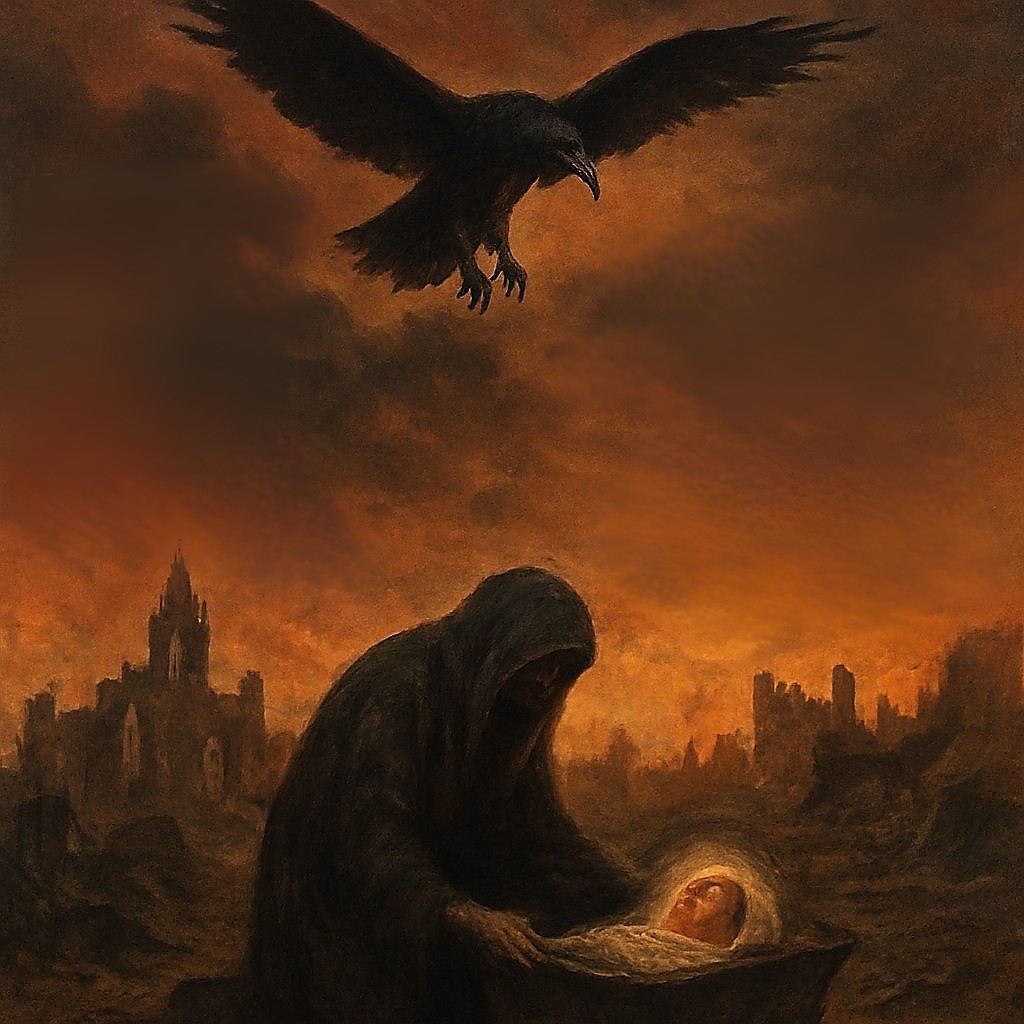
No longer are things viable in the way they were after such destruction and loss of life. A new world must be born, unless we treat things as they are. That action commits us to further death and destruction: “Things fall apart; the centre cannot hold.” Passionate intensity is not seen as helpful, but rather as the worst. As the body of Christ, now fully vulnerable as the world grasps for renewal, Yeats wonders what that “Spirito Mundi” (the Spirit Soul) is, found where Jesus was born. As the vultures circle overhead, casting, like a reel, their shadows on an already dark land, Yeats wonders:
The darkness drops again;
but now I knowThat twenty centuries of stony sleep
Were vexed to nightmare by a rocking cradle,
And what rough beast, its hour come round at last,
Slouches towards Bethlehem to be born?
Therein lies the need for us to see things anew, and step out, for the sake of creation, and for the sake of ourselves. What are we allowing the incarnate word to become if we, motivated by words that promise care for our world, yet, as Paul reminds us, fail to put on the mind of Christ, to turn, to step out, and to go? When things fall apart, what are we helping to be born?
“Well, what do we do with the information we gathered? Is it going to be one of those church things we do and consign to history?”
The two sons are both the Pharisees of yore and of us. One holds to the word, but does not achieve. The other initially declines yet labours long and hard in the vineyard. Stepping out of entitlement and deeper into an ecology of grace, we are called into the ergonomics of being agents of change who reflect that basic instinct to steward all that we see. Our feet must turn and move further into the reality that our world is groaning, as Paul would later point out, in labour pangs of new birth. Then, the question W.B. Yeats asks us in 1919 is, “What rough beast is about to be born?”
I leave you with the following for further contemplation, prayer, repentance, and a call to be people engaged in action. In action. Not inaction.
When things fall apart, what emerges from us?
More fear? More consumption?
More protection of what is ours?
More blaming previous generations?
More promises without action?
Or the mind of Christ: humility, self-emptying, service, reconciliation, life?


Leave a Reply