
This week, there were several attempts at writing my homily. One focused particularly on the translation rendered ”wise”. Prudent would be a better word, and it would refocus the parable away from judgment and toward dereliction of duty, something Amos certainly points out.
The parable of the ten young women is not about who’s in and who’s out. It’s a quiet call to the Church — be ready for the long haul, learn the slow work of justice and keep your lamp lit. The kingdom of God is near; watchfulness isn’t a shortcut but a way of being formed over time.
So many of us heard that parable as kids, fearing the door was being shut right in front of you five in five out. God as doorkeeper.
All ten of them. All ten of them get tired. All ten of them are amazed at how long the night lasts.
- The difference is not moral purity — it’s preparation.
- The Greek word for fool or foolish (mōros) isn’t about wickedness at all. It’s about lack of practical wisdom — not thinking ahead, not having the sense to plan for the long haul. This is not a story about who gets into heaven. It’s a story about how much it costs to be ready, stay on guard. Amos is talking to those who are looking for the Day of the Lord and think that will be the day of light for them. Amos says no, it might be a day of darkness rather than light.
- The prophet is speaking to a community that has mixed religious performance with justice
- They have full worship calendars, all kinds of festivals, great offerings, and God says to them: I hate them; I despise your festivals (Amos 5:21)
- What God wants is something that calls for steady capacity: justice flowing down like waters, righteousness like an uninterrupted stream (Amos 5:24)- Ever flowing. Not a flashbulb moment, not a march, not one emotional Sunday. A river that keeps on moving. In Matthew’s story, the ten young women aren’t outsiders. They are the community waiting together for the same bridegroom. All of them want to be there. All of them want to be ready. It isn’t longing at all; it’s readiness. The Church is a people who wait and watch, ready for what is coming. The oil isn’t grace (grace can’t be bought) — the oil is quiet work within you, cultivated habits, reserves you’ve built up over years that keep the flame burning when night is long.
- The Baptismal Covenant language is perfectly natural here: ‘Will you persevere in resisting evil? When you fall into sin, will you repent and return to the Lord?’ Perseverance is a covenant word — it means long haul. The five who ran out of oil didn’t prepare at all for the waiting. They were ready for the arrival, not the long delay. Don’t grieve like those without hope. There is a pace to hope.
Paul writes to a grieving community. Some have died, and there is fear that they missed it all. Paul’s word is gentle. God’s time is not our time. The dead are not forgotten. Hope doesn’t rush.
Paul is not drawing a map to the end. He looks after a tired community; when their own resources run out, he steps in.
They burned bright and fast, and when the dark came they had nothing at all to say about it.
- ’Do not grieve as those who have no hope’ (1 Thess 4:13) — note Paul doesn’t say ‘do not grieve’. Grief is real. He’s talking about the nature of grief—without a horizon or hope versus within the context of promise. Back to River from Amos. Ever-flowing. A river doesn’t bang into view. It moves quietly, making new channels, feeding things that grow beside it. Church at its best isn’t a firework. It’s a river. Beautiful in light and powerful because it goes on.
- The five wise young women, when asked to share their oil, say: No, there won’t be enough for you and for us. You had better go to the dealers and buy some for yourselves’ (Matthew 25:9). This is not selfishness. It’s truth. Nobody can fill your lamp for you. Nobody can pray in your place; nobody can bear your yearning for justice. The community will hold you, but you have to tend the flame. Let the closing be an invitation. This is a community where you fill your lamp. What you do here in prayer, kindness, and search for justice is the oil. You don’t wait for the bridegroom to start.
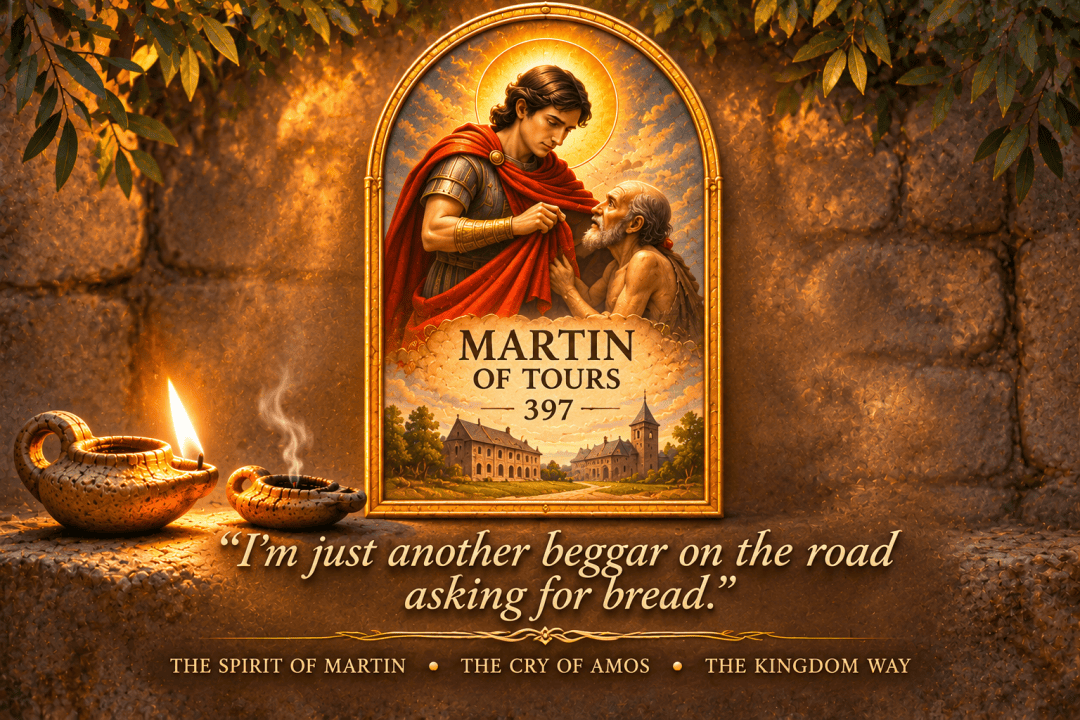
This week the Church celebrates the feast day of Martin of Tours. Martin tore his coat in half and gave it to a cold man — that man turned out to be Jesus. Amos says, “Why are there so many cold people?” In so many ways, through Martin of Tours and sharing a coat, Amos’ questions are as relevant now to our modern Church as they were then to Israel, the Church in Rome, and throughout the centuries.
Each of us is just another beggar seeking bread.
We are called to open our eyes and not lift our hands in sacrifice if we are not prepared to meet the needs of the hungry, the cold, the orphaned, the widows, and the challenged in our community.

